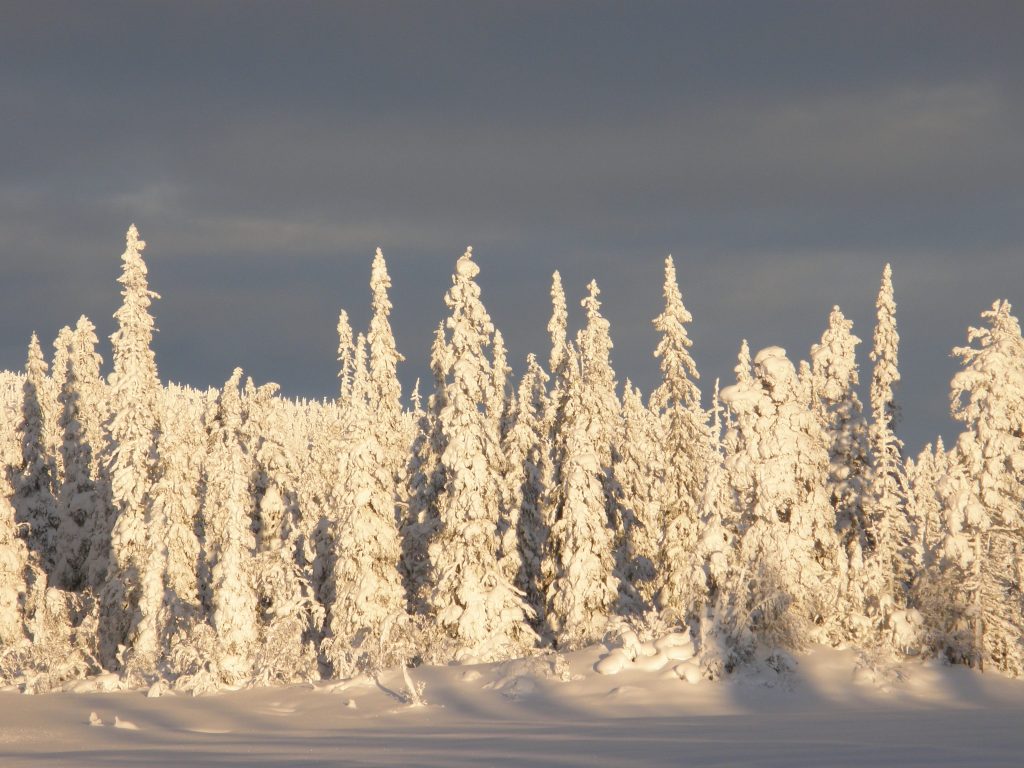
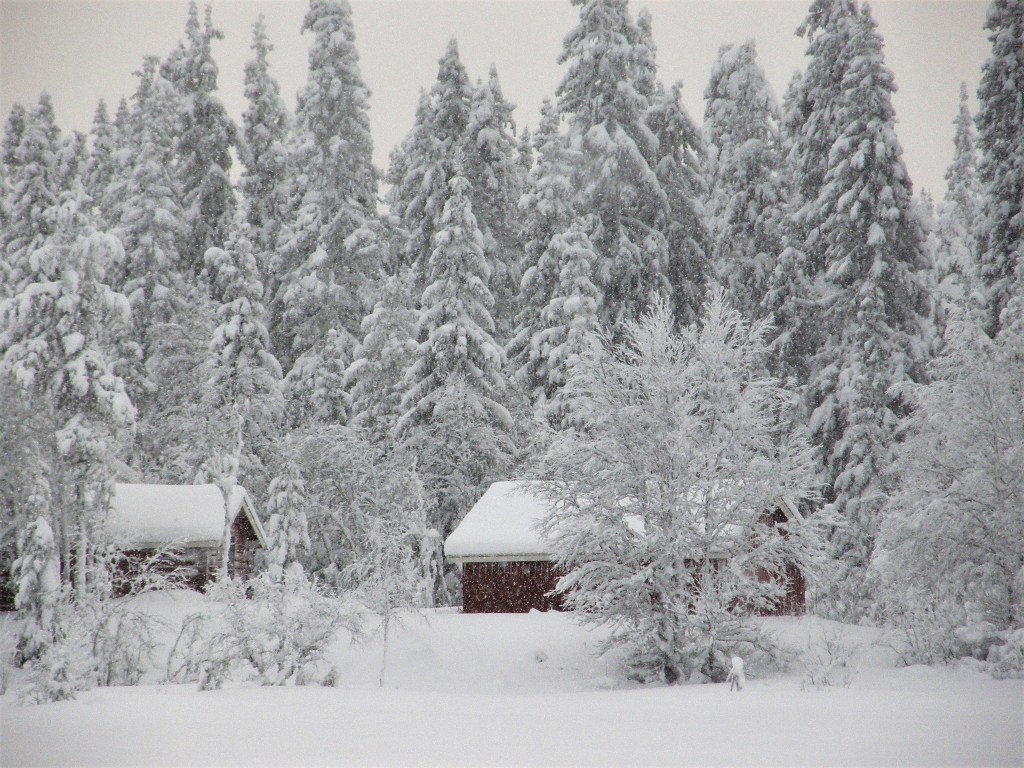
The thermometer stands at minus twenty. Large snowflakes are falling softly from the sky and this softly adds to the old snow on the ground. It’s Christmas Eve, the evening of big expectations. The birds get a new sheaf. The goats in the stable get an extra wisp of hay. The dog, Ruff, gets a nice bone, and the chickens are fed corn, which they love. On Lars’ farm the Christmas preparations are in full swing. Lars has been out and cut a fine Christmas tree. Stockfish has been in soak to be soft. Maria has baked special Christmas bread and gingerbread, made sausages, jams, meatballs, pickled herring, boiled pig’s feet and ham, porridge and … There is much to do for Christmas. Anna and Erik have been with them one night and made candles. It is a tradition of Lars and Maria.
Anna and Erik are invited to celebrate Christmas with Maria and Lars. Maria and Anna work in the kitchen, while Lars and Erik try to get the Christmas tree to stand straight, neat and well-dressed for the evening.
“According to Jämtland tradition, the Christmas preparations should be ready to ‘Sjurmäss,’” says Maria a bit apologetic.
“Sjurmäss? What is that?” Anna looks puzzled.
“Sjurmäss is something old here in Jämtland. It is the day before dipping day, as they say in the rest of the country, that is, Christmans Eve.”
“Hmm, interesting. I’ve never heard of it.”
“No, outside Jämtland not so many people who know about it. But, I read that Sjurmäss formerly was called Old Christmas.”
“So it is a kind of old Christmas?”
“Well, one might say that. I think it was before we became Christians.”
“That is a pagan ‘Christmas’ or rather a pagan party.”
“Exactly.”
“Yes, it’s a bit funny that our Christmas celebrations, to commemorate the birth of Christ, are not on the correct day. It was not the twenty fifth of December that he was born.”
Lars, happens to come by and hears the conversation, blending in.
“Well, it may be that the Christians took over a pagan festival, Yuletide, that was at the winter solstice. Probably easier to get the Christmas feast accepted that way,” says Lars lecturing.
“That we have retained the concept of Yule is also interesting,” thinks Anna.
“Yes, in most Christian countries it is called something with Christ, as in England where it’s called Christmas, that is Christ’s mass.”
“What does Yuletide actually mean, that it is the pagan festival?”
“It’s a moot point!” Lars laughs. “But an interesting explanation could be that it means horse festival.”
“Horse Fest!” Anna looks surprised.
“Yes, it was the feast when people ate horse meat. In the pagan times horses were almost a sacred animal, or at least a very valuable animal. The Norse called horse ‘jor’ and party could be called ale. The merger of these would then be ‘jol,’ meaning horse festival.”
“Well one can imagine. It does not sound unreasonable,” says Anna and she looks a little excited. “We all sing about Staffan, who was a stable boy and guarded his steeds five ….”
“Well, who knows? Maybe there’s a connection,” says Lars and goes to fetch the extension cord he will connect to the Christmas tree.
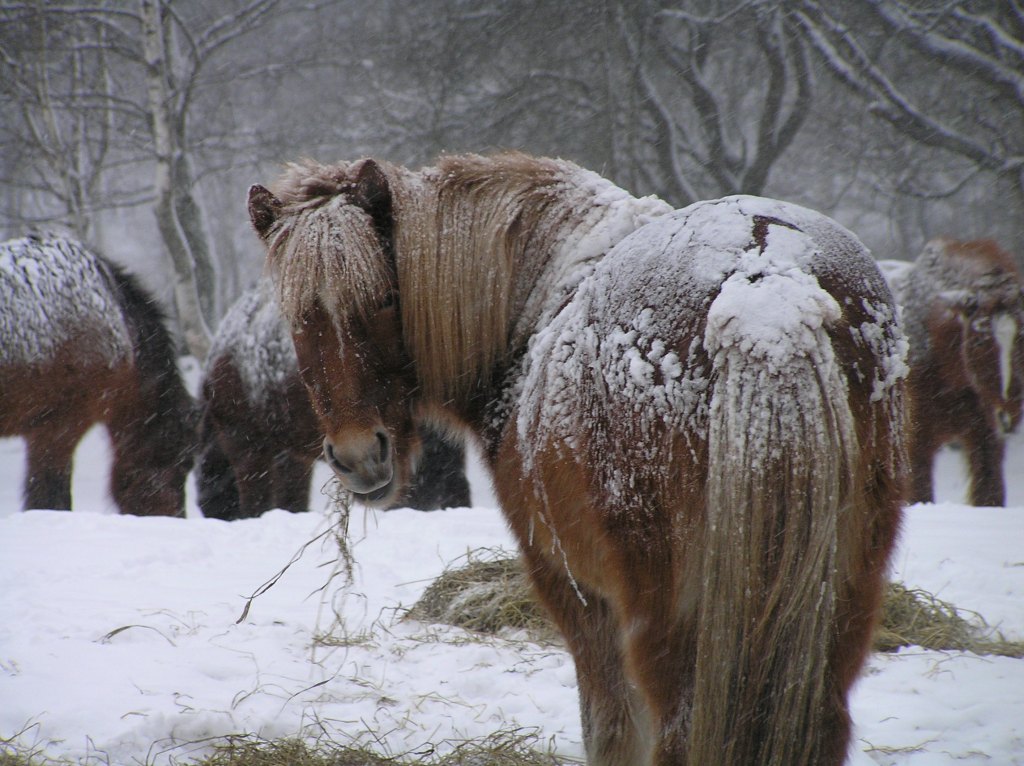
At one o’clock, they dip bread in the pot where the ham has been boiled, eat extra fine pork and drink schnapps. After that, all have rosy cheeks and slightly misty eyes.
“Maybe we should put out a bowl of porridge for the brownie in the stable,” says the affable Lars.
“Do you believe in such things,” wonders Anna surprised, since she did not perceive a twinkle in Lars’ eyes.
“Sure,” says Erik convincing. “Don’t you know? Without the farm brownie, it can go bad on the farm. Therefore, it is best to keep him friendly.”
“Sure, now I remember. Forgot that about the farm brownie,” Anna says, laughing. “Now she has got the message. It’s clear that the brownie should have a bowl of porridge.
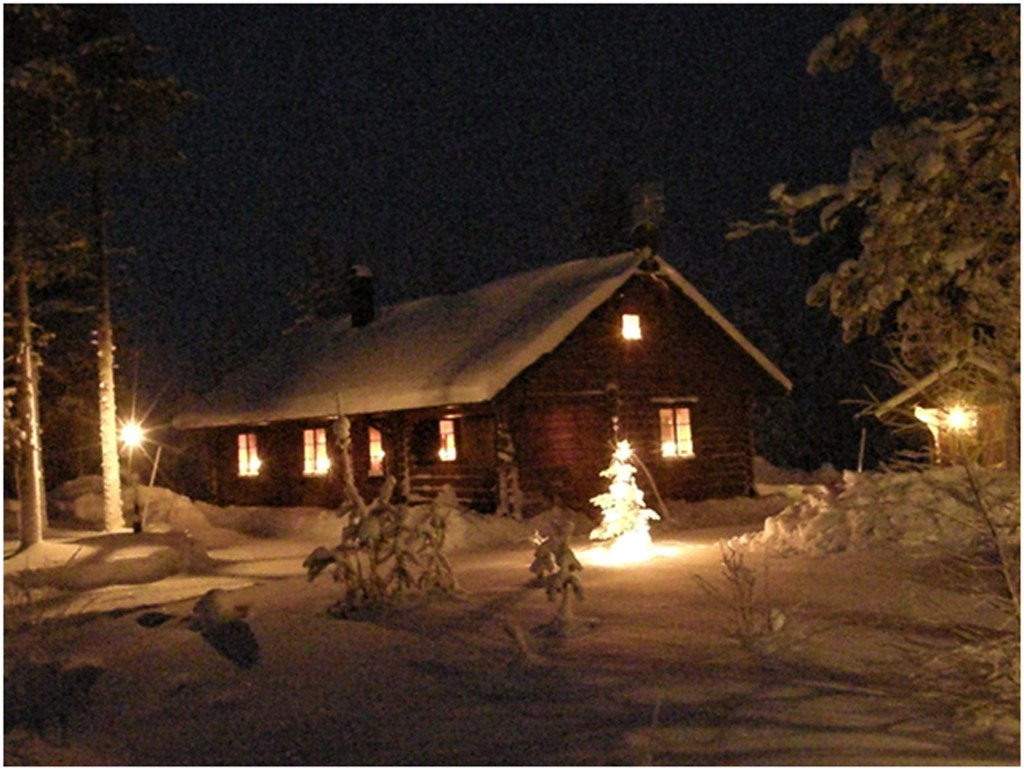
The entire farm’s windows are lit by Advent candles, and in the courtyard there a large Christmas tree which glitters. Ruff is on the couch and thinks about why everyone is so excited this cold day and when the snow is still falling. The cat walks around the house and watches that everything is as it should be. The dog, the lazy-bones, is as usual on the sofa and relaxes. It is not much of a watchdog, thinks the cat. Lars and Erik try to get together some rhymes on the Christmas presents and they are neither better nor worse than they used to be, despite the hilarious mood.
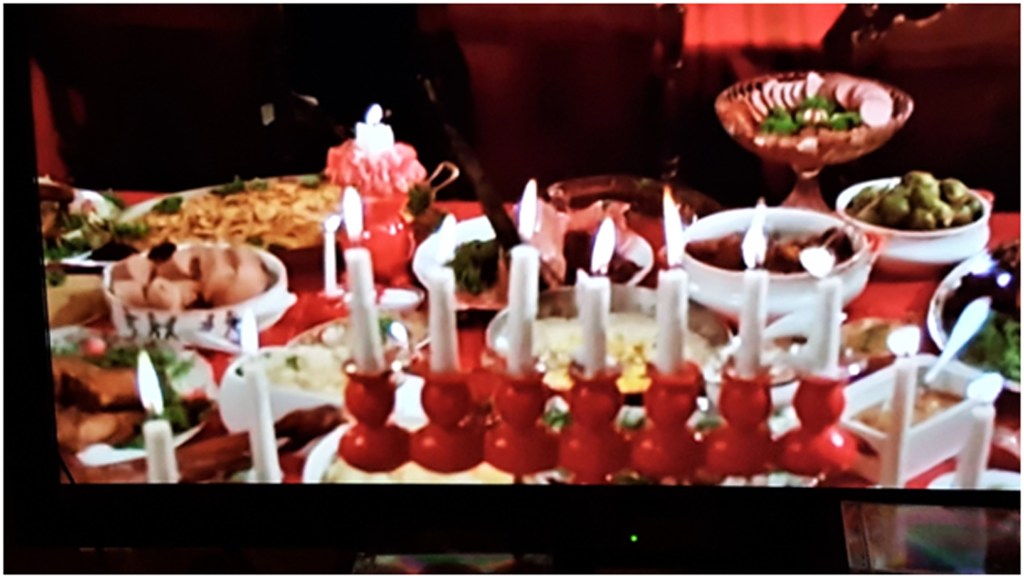
At a real Christmas dinner at Maria and Lars’s, there should be lots of food. At least three kinds of herring, cheese and beetroot salad are served. Boiled pig’s feet are a tradition, like the meatballs and the “prince sausage”. Ham, cabbage and “Jansson’s Temptation” also belong to the Christmas table. Stockfish is important, a favorite of Maria’s.
When it’s time for Christmas dinner, it is dark outside and the windows have become misty. Lars insists on a moment of quiet and contemplation before eating. Erik reads the Christmas magazine “Christmas in Jämtland,” while Maria and Anna are still puttering in the kitchen.
“We celebrate Christmas to commemorate the birth of Christ and therefore I will now read the real Christmas Gospel to you,” says Lars somewhat seriously, when everyone is gathered.
Lars reads Luke with great seriousness and the others listen dutifully.
“Now let’s sit down,” says Maria up and challenging since Lars stopped.
“I heard on the radio, I think it was the third advent, that ‘now it’s Advent, which means that we wait for Santa Claus’! Have you heard, how stupid! It’s ignorance that is breathtaking. And this we should be hearing on the Swedish Radio,” said Lars indignantly.
“But perhaps it was children they were aimed at,” Anna trays.
“It does not matter if there are children. They should learn that we give each other gifts in memory of the greatest gift we ever had, second only to life, which is the baby Jesus.”
“Is that so?”
“Of course, what else would it be?”
“That we benefit the moneylenders and mammon perhaps,” says Erik mockingly. “Now I think we should toast for Christmas and friendship. Cheers!”
“This herring is delicious, Maria,” says Anna.
“Maria makes the herring herself,” says Lars and nods to Maria.
“It is clear that Christmas must have something to do with love, with love of neighbors,” says Erik, casting a loving glance at Anna.
“Yes, exactly. Christmas is the celebration of love, though some believe it is midsummer,” says Lars.
“It fits well with the maypole, an old fertility symbol.”
“Well, Midsummer, that really should be celebrated at the summer solstice, the ancient Nordic rite.”
“Cheers!”
“I’m not used to eating pig’s feet, but it’s good,” says Anna, though she really thinks it’s a strange dish.
“I think we think about midsummer and love because nature and everything is so beautiful then,” says Anna and looks a little dreamy.
“Funny that we’re sitting here on Christmas Eve and talk about midsummer,” says Maria.
“ In its way, it is a part of our ancient culture. In pagan times, they celebrated the summer solstice and winter solstice. The sun has always played an important role in people’s lives all over the world, I think,” says Lars explaining. He’s a little hard to let go of the teaching role, even with colleagues.
“Amazing how much good food you cook, Maria. But unfortunately, I cannot eat both stockfish and ham with cabbage. Because I love ham, I’ll refrain from the stockfish,” says Erik, who does not want to say that he does not like stockfish.
“But stockfish with this mustard sauce is what’s best on the Christmas table. You need to taste,” says Maria, who herself loves stockfish.
“Okay, I’ll take a little bit, so I do not miss the tastiest.”
Maria looks happy and hands over the stockfish to Erik. He takes a little bit, too small to Maria’s mind, and pours over much mustard sauce.
“Yes, it’s the sauce that makes stockfish good,” says Lars.
“Really nice stockfish, Maria,” says Erik. “Cheers!”
Lars, whose nose is now a little ruddy, is leaning against Anna and says with an authoritative voice,
“Now that it’s Christmas, we drink a glass or two. But I’ll tell you that I think people in the village drink too much.”
“Oh, how come?”
“Here, people cannot socialize without drinking. It’s a hell of drinking on the weekends. It happens even that people are driving after drinking.”
“Yes, I know,” says Anna. “But that’s illegal!”
“Not here! Here we have our own laws,” says Lars sarcastically.
“It’s the Wild West here,” Erik fills in.
“The strong will win?”
“No, not exactly. The one with luck wins, that is, those who do not suffer an accident. As long as nothing happens, you can drink and drive. But an accident is not a good thing. Then the Swedish Law comes after you.”
“Do people also drink moonshine?”
“Of course! You can just drive over to Norway to buy a distillation apparatus perfectly legally.”
“And here it is no snitch!”
“What are you sitting there, whispering about?” wonders Lars. “Come here and get some liqueur and coffee. It is needed on top of all this food.”
When Anna and Erik go home, it has stopped snowing. The starry sky glitters over the village and the snow is crunching.
“Come here in time for Christmas mass,” Lars shouts after them. “You must be here by six o’clock. Then, the horse and sleigh leave for the church in Kall.”
“We will be here on time,” promises Erik, waving to Lars.
“Do you see Erik, where we have the northern lights again?”
“Yes, it tends to be strongest before midnight.”
“Isn’t it amazing,” says Anna and sneaks her arm under Erik’s.
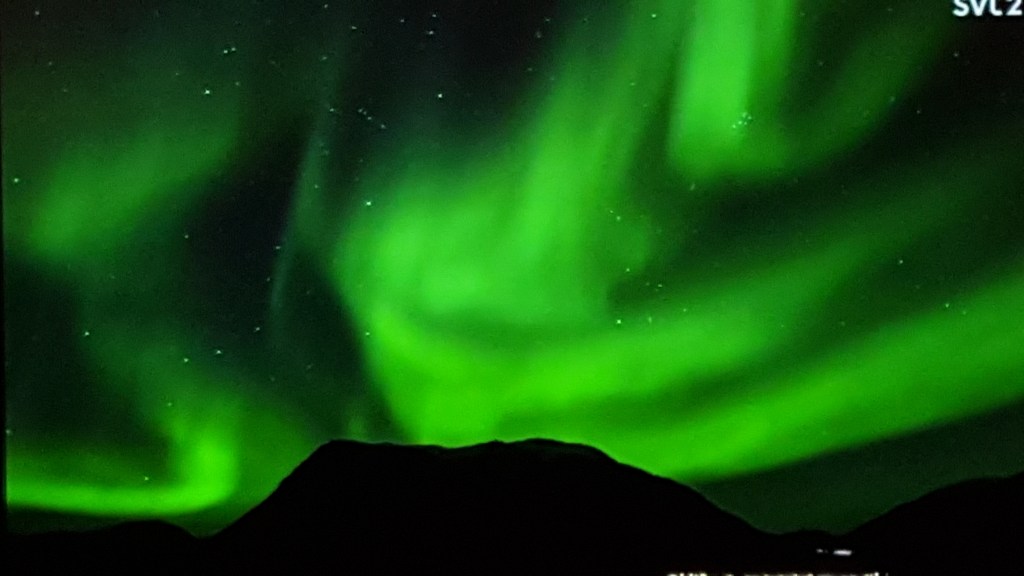
Together they go on the creaking snow through the village, with the Milky Way’s myriad stars above, and the aurora borealis fluttering like a curtain in the north.
“Come, let’s go in,” says Erik when they come to the teacher’s apartment.
“Okay.”
Erik starts when the alarm goes on at five. My God, it is already time. He has just fallen asleep. He pokes Anna, who does not want to wake up.
“Anna, now we have to get up!”
“I do not want to,” she answers sleepily.
“We’re going to the early service in the Church. We have agreed with Lars.”
“I cannot!”
“Oh yes!”
“I am totally exhausted.” She lies like a dead fish.
“But, it’s no effort. We will ride in the sleigh there.”
“That, I do not care about.”
“You said it would be so exciting to go sleighing.”
“That was yesterday.”
“Christmas mass is full of atmosphere. You will regret it if you fail to go.”
“No, I do not think so. I do not usually go to matins, and now I’m dead tired.”
“It does not look good if you’re not going. And you can sleep when we get home.”
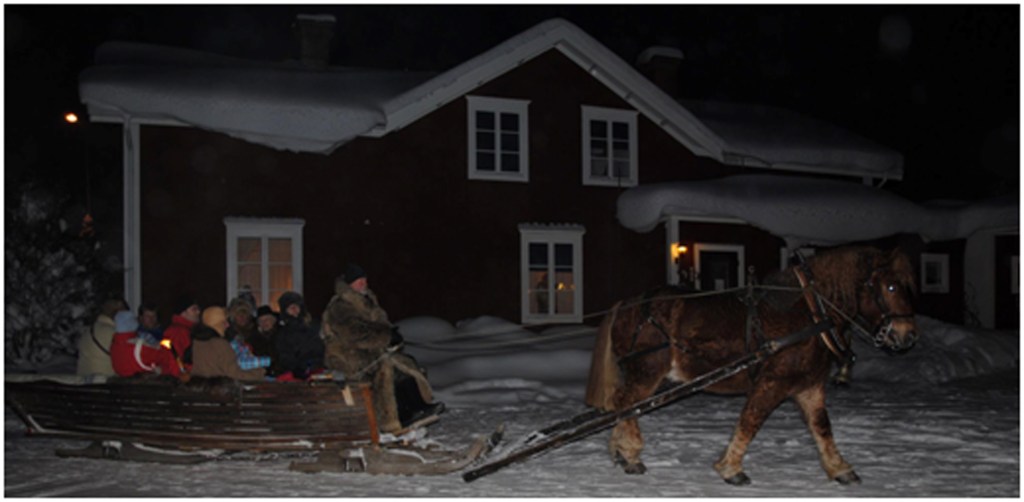
Slowly, under the influence of the shower’s comfortable, consistent heat, her body wakes up. At Lars’ farm a horse and sleigh is ready and the torches are lit, when Anna and Erik come trudging.
“You look tired,” says the lively Lars.
“Yes, we are tired,” says Erik a little sullenly. Anna says nothing, just nods.
Maria comes out with reindeer skin, as she warmed up for the departure.
“Good continuation of the holidays,” she says happily.
“The same to you,” mumbles Erik.
“Then, off we go,” shouts Lars and slaps a bit with the reins.
On the way out of the village, they will catch up with several others who are going to matins by horse and sleigh. The torches cast shadows on the snow and sleigh bells are heard along the way. Then they go down on the ice road and across the lake.
“Once again this ice road,” thinks Anna’s sleepy brain. A few days ago, she read in the local newspaper about a man who went through the ice with his snowmobile on the Big Lake. Can one really be sure that the ice is safe? She is cold, and presses herself against Erik.
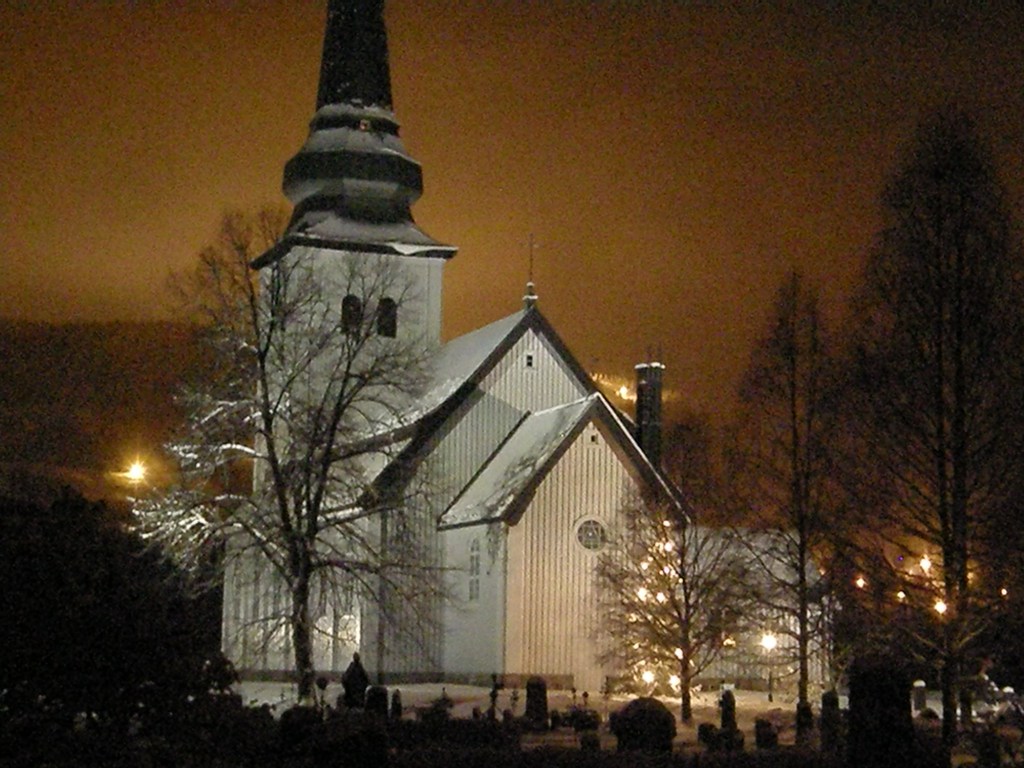
The church is nicely lit with torches leading the way up. Everything is very emotional, just as Erik said. But during the sermon, she falls asleep near the end. She has really made an effort to stay awake. She sees the candles in the aisle as in a fog. They have a halo around them. When the cantor and choir strike up Handel’s “Hallelujah!” she is wide awake. She looks around anxiously. Have people noticed that she had been half asleep?

 Kritikern Alf